

There is no magic page count, but there is a right length. Here is how long a proposal should be, what drives it, and why shorter usually wins.
"How long should a proposal be?" is one of the most common questions freelancers ask, usually whilst staring at a half-finished document, wondering if it is too thin or too bloated. The honest answer is that there is no magic page count, but there is a right length: long enough to answer the client's questions, and short enough to be read in full.
Propelio is proposal software built for freelancers and small agencies who write and send proposals to win client work, and we see proposals of every length. The ones that win are rarely the longest. This guide covers how long a proposal should be, what drives the length, and why brevity usually beats bulk.
The short answer
For most independent businesses, a proposal of two to four pages is the sweet spot. That is usually enough to cover the client's problem, your approach, what you will deliver, the timeline, and the price, without padding.
Some projects justify more. A complex, multi-stage engagement might run to eight or ten pages. Some justify less: a repeat client who already knows you might need a single page. But if your proposal is regularly stretching past ten pages, the length is probably a symptom of a deeper problem, usually a lack of focus.
Length is an outcome, not a target. You do not set out to write four pages. You write what the proposal needs, then cut everything that is not earning its place.
What actually drives the right length
The correct length depends on a few real factors, not on a rule.
Project complexity. A one-off logo costs less explanation than a six-month rebrand with multiple workstreams. The more moving parts, the more the client needs spelled out.
How well the client knows you. A cold prospect needs more reassurance about who you are and why you can be trusted. A returning client needs almost none. Adjust the proportion of selling to specifics accordingly.
Decision-maker count. If your proposal has to be passed around an organisation for sign-off, it needs to stand on its own and answer questions you will not be in the room to handle. A proposal for a single freelancer-to-founder conversation can be leaner.
Risk and price. A higher price naturally invites more scrutiny, so a larger investment usually warrants more detail to justify it. A small, low-risk job does not.
Weigh these, and the length tends to settle itself.
Why shorter usually wins
Given the choice between two proposals that cover the same ground, the shorter one almost always performs better. There are three reasons.
A client is far more likely to read a short proposal in full. A long one gets skimmed, and skimming means your strongest points may never be seen.
Brevity signals clarity of thought. A proposal that gets to the point quickly suggests you understand the problem well enough to be concise. A sprawling document can suggest the opposite, that you are unsure what matters and so included everything.
Long proposals often pad with material that works against you. Pages of company history, generic boilerplate, and filler about your "passion" dilute the parts that actually sell. Every paragraph that does not earn its place makes the client work harder to find the parts that do.
Length is really a question of structure. Our guide on how to write a winning proposal covers the structure that keeps a proposal tight.
What a proposal must contain, regardless of length
Whether your proposal is one page or eight, a few elements are non-negotiable. Get these in, and you can trim almost everything else.
- The client's problem, in their words. Show you understand what they actually need.
- Your recommended approach. What you propose to do, and briefly why.
- Deliverables and scope. Exactly what the client gets, and what they do not.
- Timeline. When the work happens and when it finishes.
- Price. Stated clearly, with what it includes.
- A simple way to say yes. The fewer steps between "I like this" and "I have signed", the better.
If a section is not serving one of these jobs, it is a candidate for cutting. That is how you control length: not by writing less, but by including only what moves the client towards a decision.
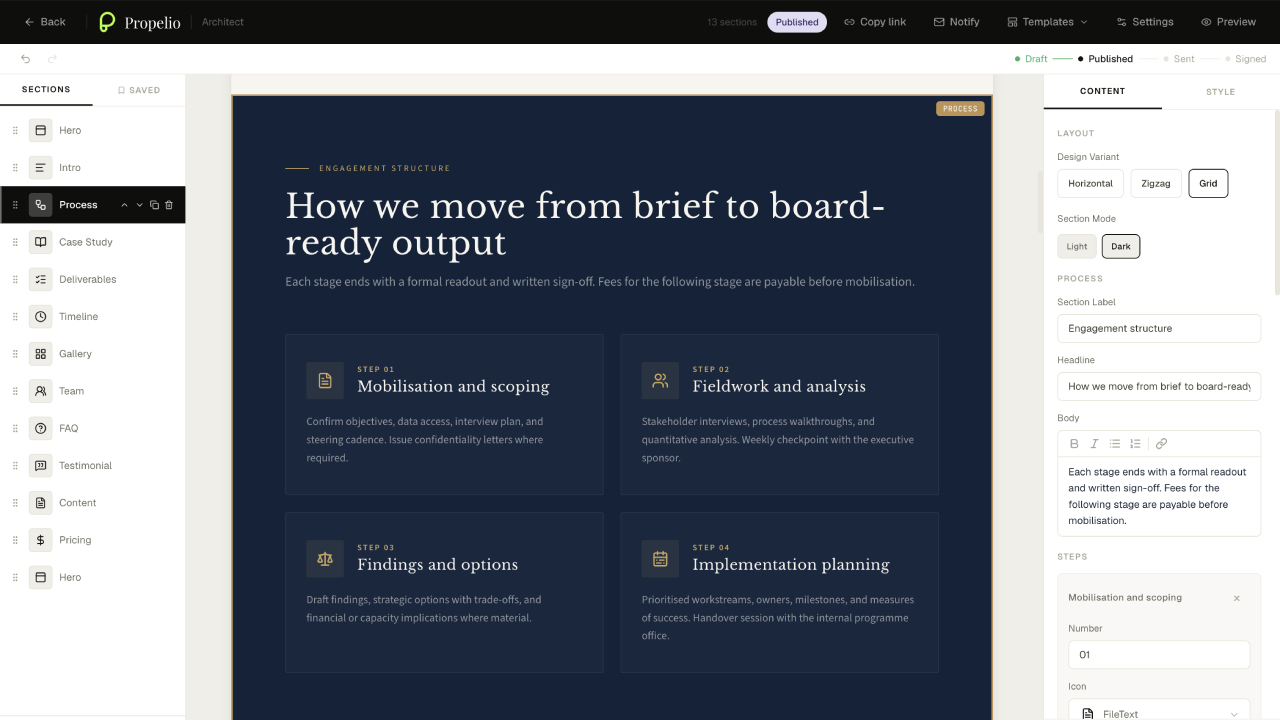
Propelio builds proposals from clear sections you can add, reorder, or remove, which makes it easy to keep a proposal focused and the right length.
For a closer look at the elements that earn their place, see what makes a strong business proposal.
How to cut a proposal that has grown too long
If your draft has ballooned, a few passes will bring it back.
Cut your own backstory. Clients care about their problem far more than your company history. One or two lines of relevant credibility is plenty.
Remove generic language. Anything that could appear in any proposal for any client adds length without adding persuasion.
Replace paragraphs with structure. A clear list of deliverables communicates faster than a dense block of prose, and it reads as more organised.
Move detail into the right place. Lengthy terms and conditions can sit at the end or in a linked document, so they do not interrupt the case you are making.
Starting from a well-structured template makes this easier, because the structure already does the editing for you. Browse Propelio's proposal templates for layouts that keep proposals focused, then add only what each client needs.
Frequently asked questions
How many pages should a proposal be? For most freelance and small-agency work, two to four pages is ideal. Complex projects may justify more, and repeat clients may need less. Page count is an outcome of covering what matters, not a target to hit.
Is a longer proposal more impressive? No. Length is not a proxy for effort or quality. A concise proposal that gets to the point usually outperforms a long one, because it is more likely to be read in full and signals clearer thinking.
What should I cut to make a proposal shorter? Start with your own company history, generic boilerplate, and any passage that could appear in any proposal. Replace dense prose with clear lists of deliverables, and move long terms to the end or a separate document.
Should pricing be on its own page? It can be, especially for larger projects where you want the price to land with its own focus. For shorter proposals, a clear pricing section within the document works fine. What matters is that the price is easy to find and easy to understand.
Does proposal length affect whether it gets signed? Indirectly, yes. A proposal that is too long risks being skimmed or left unread, which lowers your chances. A focused proposal that respects the client's time is more likely to be read fully and acted on.
The bottom line
There is no perfect page count. The right length is however much it takes to answer the client's questions, and not a word more.
For most proposals, that lands between two and four pages. Cover the problem, your approach, the scope, the timeline, and the price, make saying yes easy, and cut everything that does not move the client towards a decision. Shorter, sharper proposals win more often than long ones.
To build focused proposals from a structure that does the editing for you, browse the templates or start a free workspace.


