

Pricing is the part of a proposal most freelancers dread. Here is how to choose a model, present your numbers with confidence, and charge your worth.
Pricing is the part of a proposal most freelancers dread. Set the number too high and you talk yourself out of the work. Set it too low and you resent the project before it starts. The pricing section is where a proposal is won or lost, so it deserves more thought than a figure typed in at the last minute.
Propelio is proposal software built for freelancers and small agencies who write and send proposals to win client work, and pricing is the section we see people struggle with most. This guide covers how to choose a pricing model, what to put in the pricing section, and how to present your numbers so the client reads them as a considered offer rather than a demand.
Start with the model, not the number
Before you write a single figure, decide how you are charging. The model shapes everything else in the pricing section.
There are three common approaches for freelance work.
Hourly or day rate. You charge for the time you spend. This is simple and transparent, and it protects you when scope is uncertain. The downside: it caps your earnings at the hours in a day, and it quietly punishes you for being fast. Clients also tend to watch the clock, which changes the relationship.
Fixed price. You quote one figure for a defined piece of work. This is usually the strongest option for proposals, because it sells an outcome rather than your time. The client knows exactly what they will pay, and you are rewarded for working efficiently. It only works when the scope is clear, so it pairs naturally with a well-defined proposal.
Value-based pricing. You price against the result the work creates for the client, not the hours it takes you. A new brand identity that helps a business raise its prices is worth more than the days spent designing it. Value pricing earns the most, but it requires you to understand the client's business and to have the confidence to hold the number.
For most proposal-led work, a fixed price is the right default. It gives the client certainty and gives you room to be paid for your judgement, not just your time.
Not sure whether you are sending the right document in the first place? Read our guide to proposal vs quote vs estimate before you set your price.
What the pricing section should contain
A price on its own invites the question "why so much?". A price with structure answers it before it is asked.
A strong pricing section includes:
- A clear breakdown of what is included. List the deliverables tied to the figure, so the client can see what they are buying.
- The total, stated plainly. Do not bury it. A client who has to hunt for the number assumes you are uncomfortable with it.
- What is not included. A short line on what falls outside scope prevents the awkward conversation later when the client expects more than you priced for.
- Payment terms. Deposit, milestones, or on completion. Say when you invoice and how you expect to be paid.
The goal is that a client reading the pricing section knows exactly what they get, what they pay, and when. No ambiguity, no surprises.
Present options, not a single take-it-or-leave-it figure
One of the most effective changes you can make is to offer tiers. Instead of a single price, present two or three options at different levels of scope.
A common structure is good, better, best:
| Essential | Recommended | Complete | |
|---|---|---|---|
| Scope | The core deliverable | Core plus the obvious extras | The full engagement |
| Best for | Tight budgets | Most clients | Clients who want everything handled |
Tiers work for three reasons. They move the client's question from "yes or no" to "which one", which is a much easier conversation to win. They anchor the middle option as the sensible choice. And they let a budget-conscious client say yes to something rather than walking away entirely.
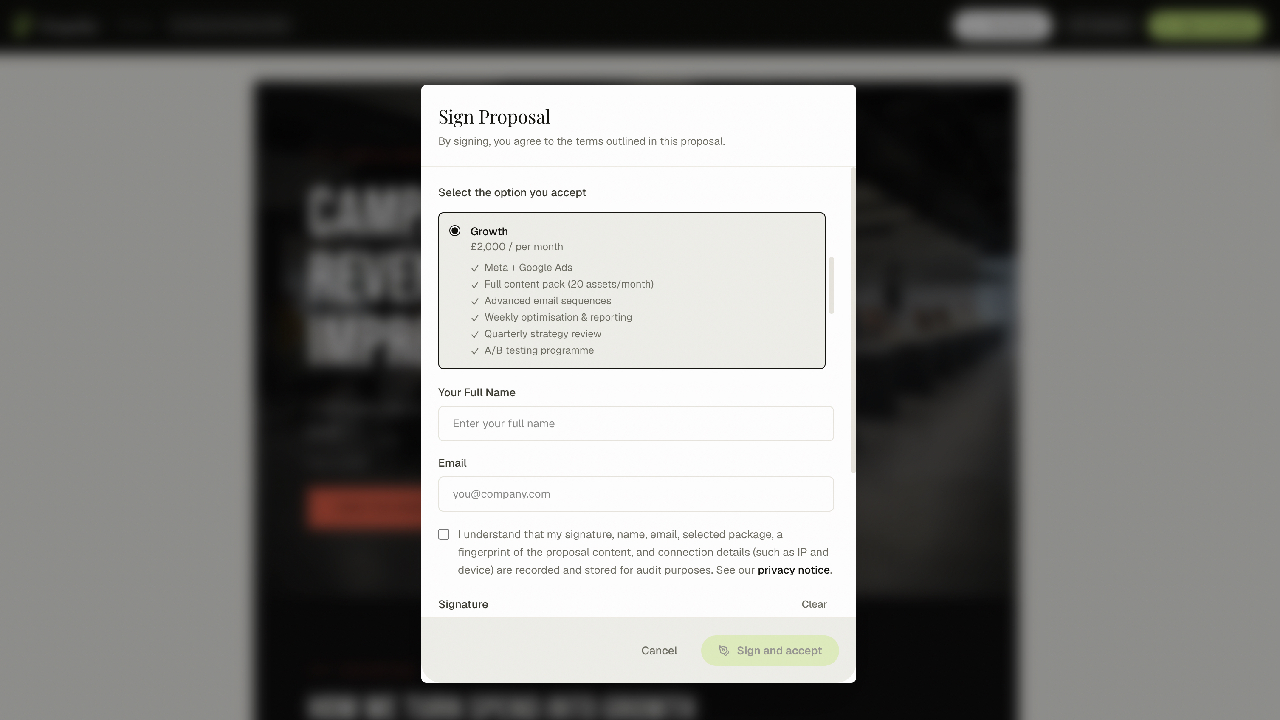
In Propelio, tiered pricing columns let the client pick their own package, monthly or annually, then sign, all inside the proposal.
If you use proposal software with interactive pricing, the client can select their preferred option inside the proposal before they sign, which removes a round of back-and-forth. Our proposal software for freelancers is built around exactly this kind of selectable pricing.
Let clients add optional extras
Some of the easiest revenue you will ever earn comes from work the client did not know they wanted until they saw it offered. A pricing section that lets a client add optional services turns a single project into an upsell, without you having to make a pushy pitch.
The trick is to present extras as a choice, not a hard sell. A maintenance retainer alongside a website build. A set of social templates alongside a brand identity. A faster turnaround for an added fee. Listed as optional add-ons, these sit quietly next to the core price and let the client opt in on their own terms.
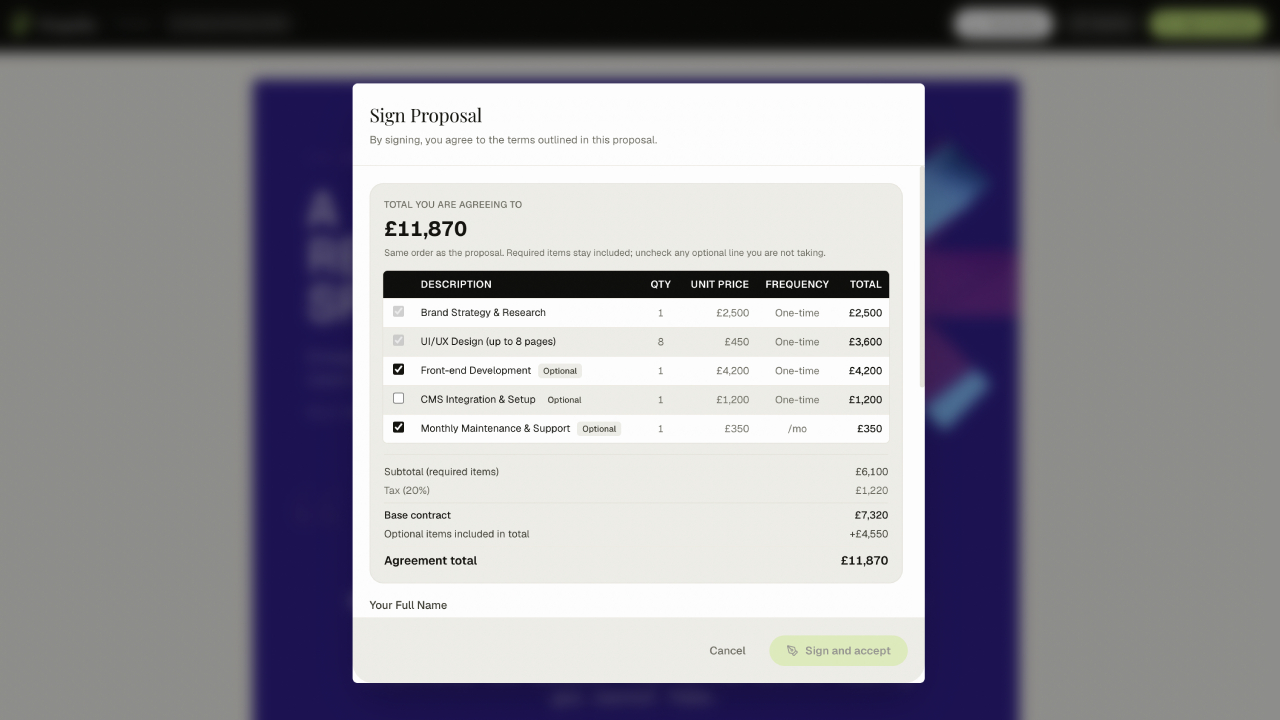
Optional services in a Propelio pricing table. Clients tick the extras they want, and a monthly or annual toggle lets you present recurring work clearly.
Recurring extras are where the monthly and annual toggle earns its place. A retainer shown as a clear monthly figure, with an annual option beside it, makes ongoing work easy to say yes to and easy to budget for. The client sees exactly what they are committing to, and you turn one-off projects into recurring income.
How to talk about price without flinching
Confidence in the pricing section is mostly about framing.
Lead with value before the number. If the proposal has already explained the client's problem and your approach, the price lands in context. A figure at the end of a strong argument is far easier to accept than the same figure in a bare email.
Avoid apologising for your rate. Phrases like "I know this might seem like a lot" plant doubt that was not there. State the price as a fact, because that is what it is.
Do not negotiate against yourself. If you fear the number is too high, the temptation is to discount before the client has even responded. Hold the figure. If a client genuinely cannot meet it, adjust the scope rather than the rate, so a lower price reflects less work rather than a cheaper version of you.
Handling "that's more than we expected"
Sometimes the budget is real and the gap is genuine. When a client pushes back on price, you have better options than a flat discount.
Reduce the scope. Move a deliverable into a later phase. Offer the Essential tier rather than the Recommended one. Each of these keeps your rate intact whilst giving the client a way to proceed.
A discount with nothing removed teaches the client that your first number was inflated, which damages trust on every future proposal. Changing the scope keeps your pricing credible.
The way you structure the whole document affects how the price is received. See how to write a winning proposal for the structure that makes pricing easier to accept.
Use a template so pricing is consistent
If you reinvent your pricing section every time, it will be inconsistent, and inconsistency reads as uncertainty. A reusable structure means every proposal presents price the same considered way.
Browse Propelio's proposal templates, such as the freelance developer proposal template, for layouts that already include a structured pricing section, then adjust the figures and deliverables for each client. Starting from a proven structure is faster than a blank page, and it keeps your pricing looking deliberate.
Frequently asked questions
Should I put my prices in a proposal or wait until the client asks? Put them in the proposal. A proposal without a price forces another email and slows the decision. The whole point of the document is to present your approach and your price together, so the client can say yes in one step.
Hourly or fixed price for freelance work? Fixed price is usually stronger for proposal-led work, because it sells an outcome and rewards you for working efficiently. Use hourly only when the scope genuinely cannot be defined in advance, and even then, cap it with an estimate so the client is not staring at an open-ended meter.
How do I price a project I have never done before? Estimate the hours honestly, add a margin for the unknowns, then convert it to a fixed price if you can. Pricing slightly higher to cover uncertainty is fairer to both sides than underpricing and resenting the work, or hitting the client with overruns later.
Should I show a discount in the proposal? Only if it is tied to something real, such as a deposit, a longer commitment, or reduced scope. A discount with no reason attached makes your original price look invented. If you need to come down, take something out.
How many pricing options should I offer? Two or three. One gives the client a yes or no decision, which is easy to lose. Four or more creates choice paralysis. Three tiers, with a clear recommended middle, tends to work best.
The bottom line
Pricing is not the moment to go quiet. It is the moment your proposal has been building towards.
Choose a model that fits the work, structure the section so the client can see exactly what they are buying, offer options rather than an ultimatum, and state your number as a fact. Do that consistently and pricing stops being the part you dread.
When you are ready to build proposals with structured, selectable pricing, browse the templates or start a free workspace and put your next proposal together in minutes.


